
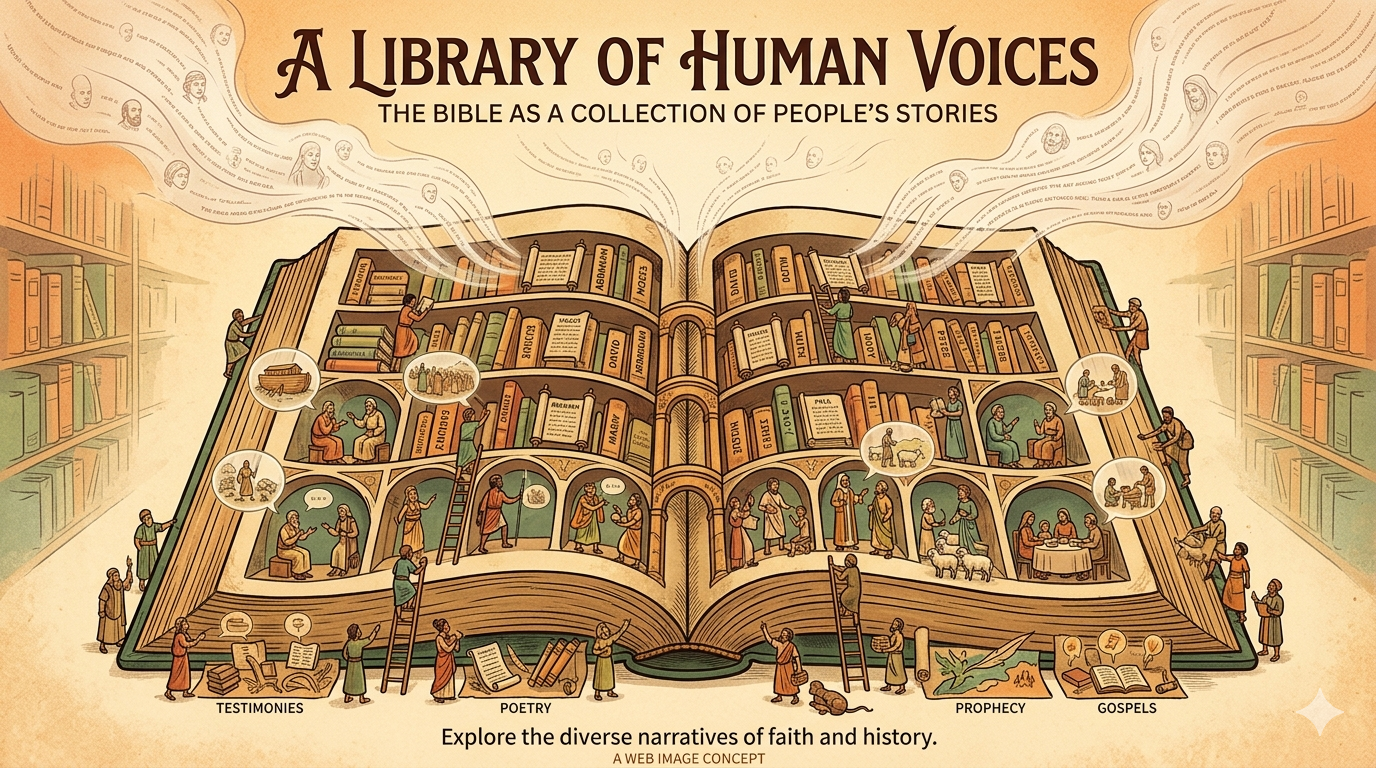
Our journey begins with the Christian Bible, but before we open it, we have to change how we see it. Most people look at the Bible as a single, thick book with one voice. In reality, it is a library. It consists of 66 individual books—39 in the Old Testament and 27 in the New Testament—written by dozens of different authors, in different languages, over the course of a thousand years.
The “One Book” Myth
The biggest misunderstanding in the world is that the Bible is a “monolith.” Because it sits between two covers, we expect it to be a perfect, consistent instruction manual. But when you treat it that way, you stop reading what is actually on the page. You start trying to make the authors “agree” with each other, which is like trying to force a poet, a lawyer, and a revolutionary to all write the same diary entry.
As scholar Bart Ehrman often emphasizes, these books are literary accounts, not modern historical ones. Today, we think of “history” as a dry recording of facts, like a security camera tape. But the ancient authors weren’t trying to be cameras; they were trying to be artists and truth-tellers. They used stories to convey deep, world-changing meanings.
The Power of the Disagreement
One of the most liberating things you can realize is that these 66 books do not always agree. * One author might see God as a vengeful judge; another sees God as a heartbroken parent.
- One Gospel writer might show Jesus as a silent, suffering servant, while another shows him as a powerful, divine king.
When we “harmonize” these stories—when we smash them together to make one smooth, “perfect” story—we actually rob them of their integrity. We silence the unique voice of each writer. If we modernize the text to make it fit our 21st-century expectations, we miss what the original author was trying to scream across the centuries.
Restoration, Not Just Reading
Our goal isn’t to be told what to do. Our goal is to uncover what these authors were actually explaining. By looking at the Bible as a collection of short stories, poems, and letters, we can finally see the “humanness” of the text. It makes the Bible less of a rigid statue and more of a living, breathing conversation. To understand this better, let’s look at one of the most famous figures in the entire collection: Jesus of Nazareth.

Yes thank you.