It is April 2026, and we are currently right in the thick of the “Semiquincentennial” (yes, that’s the official 250th-anniversary word, and no, it’s still not easier to say). Since the main event is just three months away, the “history” portion of the celebration is basically everywhere you look—from your pocket change to the highway.
How “well” the Founding Fathers and history were integrated depends entirely on who you ask, as the celebration has become a bit of a mirror for our current times. Here is how it’s playing out so far:
The “Founding” Focus: High-Octane Patriotism
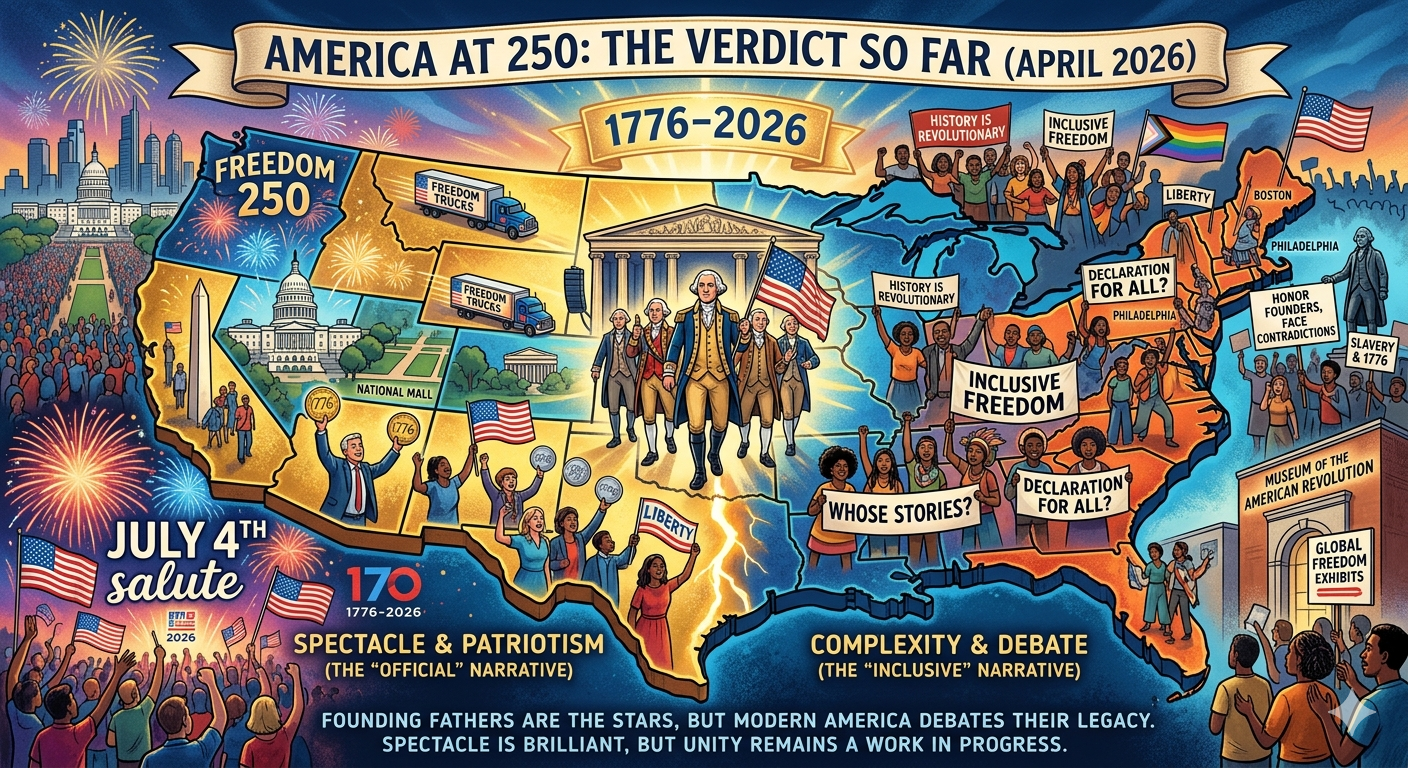
The official Freedom 250 initiative (the White House-led task force) has doubled down on the “Spirit of ’76.” If you’re a fan of the classics, they’re hitting all the high notes:
- The “Freedom Trucks”: Six massive mobile museums are currently crisscrossing the 48 states. They focus heavily on the “miracle at Philadelphia,” showcasing the ingenuity of the Founders and the revolutionary nature of the Declaration of Independence.
- Washington’s Lead: We’ve already seen major reenactments this year, like the 250th anniversary of Evacuation Day in Boston (March 17) and Washington’s Birthday festivities. Coming up later this month is a massive reenactment of Washington’s first inauguration at Federal Hall.
- The “Dual Date” Coins: The U.S. Mint has released the “1776–2026” quarters and dimes. The new designs are gorgeous, though good luck finding a “Liberty Bell” quarter in the wild—collectors are snagging them immediately.
The “Inclusive” History: A Broader Lens
While the official federal narrative is very “Founding Fathers forward,” organizations like the Smithsonian and the Museum of the American Revolution are trying to tell a “360-degree” version of 1776:
- The “Declaration’s Journey” Exhibit: This has been a hit in Philadelphia, showing how the ideals of the Founders actually traveled away from them—influencing global freedom movements and being used by abolitionists and suffragists to hold the nation to its own promises.
- Local Legends: Many states are focusing less on the “Big Names” and more on local Revolutionary heroes, including women, Black patriots, and Indigenous leaders who were often left out of the 1976 Bicentennial.
The Friction: History as a Battlefield
It wouldn’t be 2026 without a little debate. There has been significant public pushback and “history wars” regarding how the story is told:
- Patriotism vs. Complexity: Some critics argue the Freedom 250 messaging is “sanitizing” history by focusing almost exclusively on exceptionalism and minimizing the era’s contradictions (like slavery).
- Political Tug-of-War: There’s been a lot of noise in Congress about the “1776 Commission” style of education being baked into the celebrations, with some historians worrying that the 250th is being used as a political tool rather than a moment for honest reflection.
The Verdict So Far
If you wanted a spectacle, they’ve done it brilliantly. The scale of the upcoming July 4th “Salute to America” on the National Mall—complete with what’s being billed as the largest fireworks show in history—is undeniably impressive.
But if you were looking for a unified national narrative, it’s a bit more complicated. The “Founding Fathers” are definitely the stars of the show, but they’ve also become the center of a very modern debate about what America was, is, and should be.
It’s a bizarre time: half the country is getting ready for the “Greatest Birthday Party in History,” and the other half is worried about whether the guest of honor (democracy) is even healthy enough to blow out the candles.