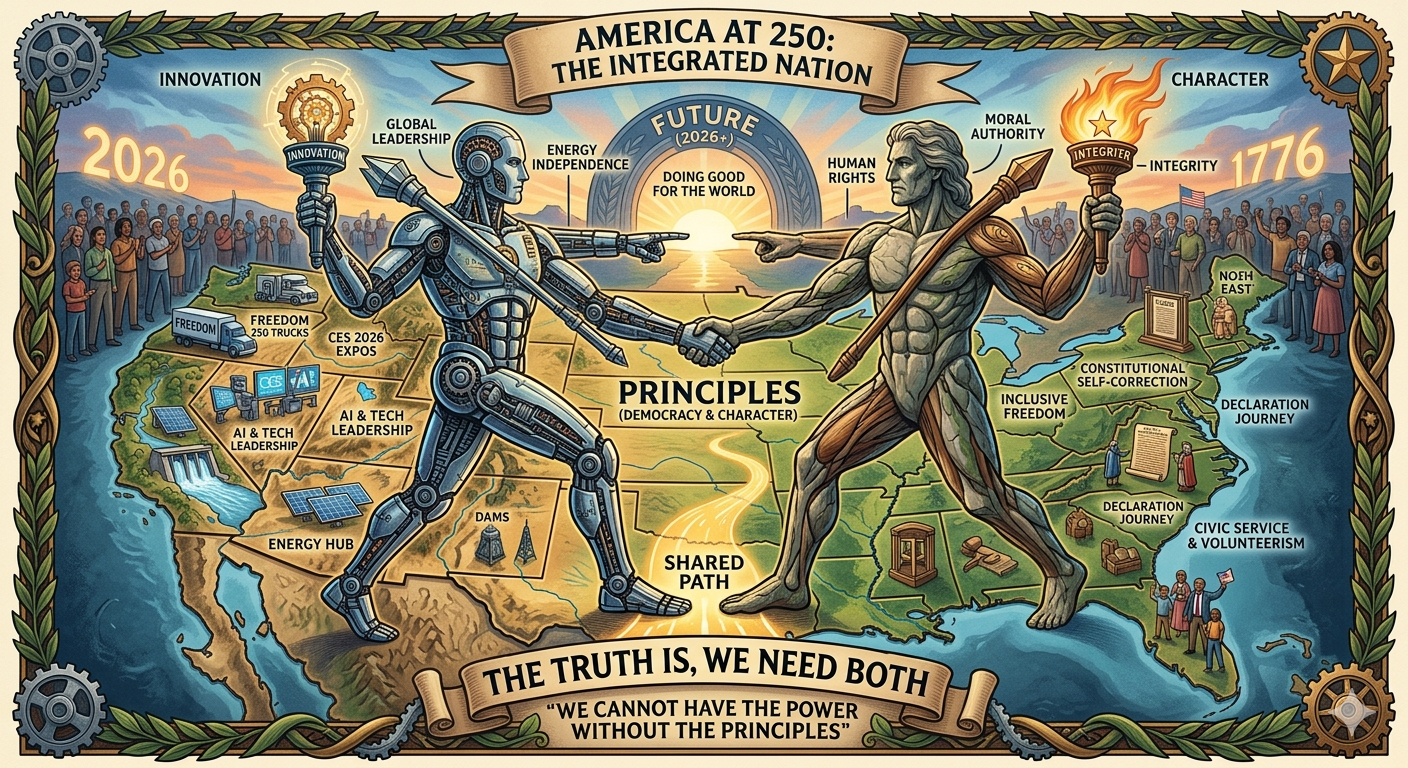
As we approach July 2026, the air is thick with the smell of funnel cakes and the glare of high-def LED screens. The “Freedom 250” trucks are rolling through our towns, the “America Innovate” expos are showing us a high-tech future, and the official narrative is one of unbridled greatness.
On paper, the “spectacle” is working. But for many of us—my half of the country—there is a persistent, vibrating alarm going off in our chests. And it’s getting harder to stay quiet about it.
The Conflict of Character
There is a specific kind of exhaustion that comes from watching a “spectacle” you don’t trust. For some, the current leadership is a means to an end—a “strongman” for a strong country. They see the tech deals, the “Patriot Games,” and the global posturing as proof of a job well done.
But for me, character is the foundation of policy. When my body tells me that the person at the center of the spectacle is fundamentally not “good,” I can’t simply ignore that because the GDP is up or the fireworks are louder this year. If the architect of the house lacks integrity, how can I trust that the roof won’t collapse on us all later? We are being asked to trade our moral compass for a front-row seat at a show, and for me, that’s a deal I can’t make.
What My “Half” Feels
If you wonder why we are angry—why we can’t just “lighten up and celebrate”—it’s because we believe that how we lead is just as important as where we are leading.
- We see the spectacle as a mask for the erosion of empathy.
- We see the “Greatness” narrative as a way to avoid the “Goodness” work of fixing our internal wounds.
- We feel that if we lose our character as a people, no amount of “innovation” can save the American soul.
Trying to Hear the Other Side
I’ve spent a lot of time being angry at the “other half.” But as the 250th anniversary nears, I’m trying to understand what they see when they look at the same stage.
I think they see security. After years of feeling like the world was passing them by or that the country was apologetic for its own existence, the spectacle feels like a protective shield. They aren’t necessarily ignoring “character” flaws; they’ve just decided that in a dangerous world, they’d rather have a “flawed fighter” than a “polite loser.” They see the spectacle as a sign of life, not a sign of decay.
The Bridge We Need
The tragedy of 2026 is that we both want the same thing: an America that does more good for the world than harm. * Their side believes we do good by being the most powerful, innovative force on earth.
- My side believes we do good by being the most moral, inclusive, and principled democracy on earth.
The truth is, we need both. But we cannot have the power without the principle. If I’m angry, it’s because I’m mourning the loss of the “moral leader” I know we can be. I’m not trying to ruin the party; I’m trying to make sure there’s a country worth celebrating when the fireworks go out.