How the Rules of American Democracy Are Being Rewritten
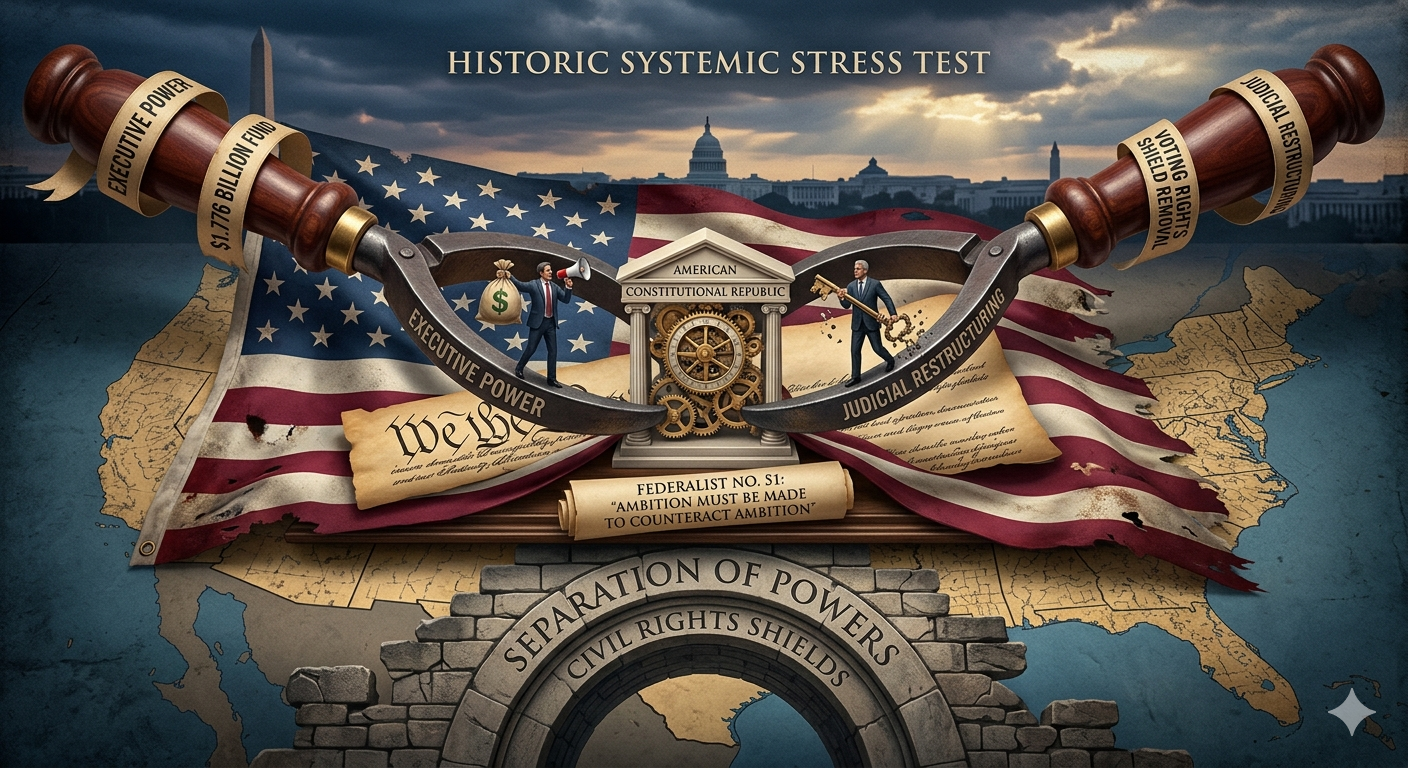
The American constitutional republic was designed by its founders to be a self-correcting machine, powered by a delicate equilibrium of competing ambitions. In Federalist No. 51, James Madison famously wrote that “ambition must be made to counteract ambition,” ensuring that no single branch of government—and no single political faction—could ever consolidate absolute control.
Today, that machine is experiencing a historic, systemic stress test.
We are witnessing a highly coordinated, multi-front restructuring of how power is exercised, how public funds are deployed, and who gets to participate in American democracy. This is not merely a collection of isolated political controversies; it is a structural pincer movement.
On one side, the executive branch is aggressively expanding its authority to reward allies, bypass Congress, and centralize control over voter data. On the other side, the judicial branch is systematically dismantling the civil rights shields that historically protected marginalized voters from state-level overreach.
To understand the full scope of this constitutional shift, we must connect three seemingly disparate threads: a $1.776 billion litigation settlement draped in patriotic branding, an unprecedented federal voter data dragnet, and the quiet evisceration of the Voting Rights Act.
Thread One: The $1.776 Billion Executive Patronage Fund
In May 2026, the Department of Justice announced the creation of an “Anti-Weaponization Fund.” Ostensibly designed to compensate individuals who claim they were “wrongly targeted” by federal investigations during previous administrations, the fund represents an unprecedented detour around the separation of powers—and it is intentionally tied to a major national milestone.
The Pageantry of the 250th Birthday
The exact total allocated to the fund is $1.776 billion, a highly calculated nod to the year 1776. The administration has deliberately integrated this fund into the grand-scale state imagery surrounding the United States Semiquincentennial—the nation’s upcoming 250th birthday in July 2026.
By framing the fund around the 250th anniversary of American independence, the administration is executing a brilliant feat of political branding. The messaging positions the payouts not as political favoritism, but as a historic “restoration” of founding liberties. It aligns the financial compensation of political allies with the patriotic celebration of the nation’s birth.
Bypassing the Power of the Purse
Under Article I, Section 8 of the U.S. Constitution, the power to allocate public funds—the “Power of the Purse”—belongs exclusively to Congress. The executive branch cannot simply invent a multi-billion-dollar compensation program because it deems it politically or patriotically expedient.
To circumvent this, the administration utilized a highly unorthodox legal maneuver. The fund was established to settle a personal, $10 billion lawsuit filed by Donald Trump and the Trump Organization against the IRS and the Treasury Department over leaked tax records. Rather than a court issuing a judgment after a trial, the executive branch essentially settled with itself.
By settling the suit, the administration tapped directly into the Federal Judgment Fund—a permanent, indefinitely appropriated Treasury fund meant to satisfy legitimate court-ordered judgments against the United States. While Trump and his family receive no personal financial payouts under the settlement, they successfully converted a private grievance into a massive public fund.
The Constitutional Impact: Financial Patronage
The structural danger here is the creation of an executive mechanism for financial patronage. The fund is overseen by a five-member commission appointed by the Attorney General, with members serving at the pleasure of the President.
Acting Attorney General Todd Blanche confirmed in Senate testimony that the commission has broad discretion to issue formal apologies and taxpayer-funded payouts, explicitly leaving the door open for individuals convicted in the January 6th Capitol riot to apply.
When the executive branch can unilaterally extract billions of dollars from the Treasury to financially reward its political base—shielded by the popular pageantry of a 250th birthday celebration—the constitutional barrier between public money and private political interest dissolves. It transforms the Treasury into an instrument of political grievance and reward.
Thread Two: The Nationwide Voter Data Dragnet
While the Anti-Weaponization Fund secures the financial flank, a parallel operation is underway to centralize control over the electoral apparatus itself. The Department of Justice, working alongside the Department of Homeland Security, has engaged in a sweeping campaign to demand unredacted, detailed voter registration files from nearly every state in the nation.
Weaponizing the Civil Rights Act
The administration has demanded files containing sensitive, personally identifiable information—including partial Social Security numbers, dates of birth, and driver’s license numbers—from at least 44 states. When state election officials balked, citing strict state privacy laws, the DOJ filed lawsuits against 24 states to force compliance.
The executive branch justified this dragnet by invoking a heavily strained interpretation of the Civil Rights Act of 1960, claiming the federal government requires this data to cross-reference state voter rolls with immigration databases to purge “ineligible non-citizen voters.”
The Constitutional Impact: Federalizing Elections
This represents a profound violation of federalism. Article I, Section 4 of the Constitution explicitly delegates the authority to run, regulate, and maintain elections to the individual states. The United States does not have a centralized, federal election system; it has 50 distinct state systems.
By demanding unredacted state voter rolls and attempting to build a centralized federal registry of “eligible” voters, the executive branch is attempting to strip states of their constitutional primacy over elections. If the federal government can dictate who belongs on a state’s voter roll using proprietary federal databases, the decentralized nature of American elections—historically our greatest defense against authoritarian consolidation—is severely compromised.
Thread Three: The Judicial Deconstruction of Voting Rights
As the executive branch expands its reach, the judicial branch is simultaneously retreating from its historic role as the guardian of constitutional rights. The most alarming flashpoint of this retreat is the Supreme Court’s recent landmark decision in Louisiana v. Callais.
The Partisan Smoke Screen
In a 6-3 decision, the Supreme Court’s conservative majority severely weakened Section 2 of the Voting Rights Act (VRA). The case centered on Louisiana’s congressional map, which had been redrawn to include a second majority-Black district to ensure fair representation under the VRA. The Supreme Court struck down the map, ruling it an unconstitutional “racial gerrymander.”
The core legal shift in Callais is devastatingly simple: the Court ruled that states can defend racially discriminatory line-drawing by simply claiming their motivations were partisan rather than racial.
In the American South, where race and political alignment are deeply intertwined, this creates a massive legal loophole. State legislatures can now dismantle majority-minority districts and dilute the voting power of Black Americans, provided they use the magic words: “We aren’t trying to suppress Black voters; we are just trying to help Republicans win.”
The Constitutional Impact: The Collapse of Equal Protection
The chess pieces are moving rapidly. The immediate fallout has been a cascade of map manipulation. Louisiana was forced to scrap its fair map, Alabama is actively working to dismantle one of its minority-opportunity districts, and states like Tennessee have effectively eliminated historically Black voting districts entirely.
When the Supreme Court validates partisanship as a legitimate excuse for racial disenfranchisement, it fundamentally hollows out the Fourteenth Amendment’s Equal Protection Clause. The judiciary is no longer acting as a check on majoritarian tyranny; it is providing the legal blueprints for it.
Is Recovery Possible? The Resilience of the Architecture
When you look at these three developments together—the creation of a $1.776 billion executive fund, the weaponization of federal data, and the judicial retreat from voting rights—it is easy to conclude that the United States has slid into an unrecoverable autocracy just as it marks its 250th year.
But a closer look reveals that the constitutional architecture is fighting back. The system is strained, but it is not broken.
The primary line of defense right now is the decentralization of the system itself. Consider the resistance to the DOJ’s voter data dragnet: election officials from both political parties have flatly refused to hand over their citizens’ private data. Bipartisan resistance from state Secretaries of State has stalled the federal government’s overreach.
Furthermore, the federal courts—including judges appointed across different administrations—have repeatedly handed the DOJ stinging defeats in these data lawsuits. Federal judges in California, Michigan, and Oregon have dismissed the administration’s claims, explicitly calling the voter data grab “unprecedented and illegal.”
The executive branch is testing the boundaries of its power, but it is hitting a wall of decentralized, institutional resistance. The autocracy is not a finished project; it is a live argument, and the counter-argument is currently being written by ordinary civil servants, independent judges, and state officials.
Reader Summary: What You Can Do
The most dangerous myth of democratic backsliding is that citizens are powerless spectators. The constitutional system only functions if the electorate engages with the mechanisms left to them.
If you are alarmed by the expansion of executive power and the erosion of voting rights, here is an actionable blueprint for impact:
1. Focus on the State Level (Where the Real Power Is)
Because the Constitution gives states the power to run elections, your local and state officials are the most critical gatekeepers of democracy.
- Action: Find out who your state’s Secretary of State and local Election Director are. Support candidates—regardless of party—who explicitly pledge to protect voter privacy, resist federal data dragnets, and maintain independent control over state voter rolls.
2. Protect Local Election Infrastructure
Election offices across the country are facing funding shortages and unprecedented pressure, leading to a mass exodus of experienced, non-partisan civil servants.
- Action: Sign up to be a local poll worker or election judge in your precinct. Democracies are secured not by grand declarations, but by regular citizens showing up to count ballots accurately and transparently at the precinct level.
3. Support Voting Rights Litigation
Since the Supreme Court has weakened federal protections, the battle has shifted to state constitutions and state courts. Civil rights organizations are fighting district-by-district to challenge gerrymandered maps.
- Action: Support non-partisan organizations like the NAACP Legal Defense Fund, the Brennan Center for Justice, or the League of Women Voters, who are actively funding the legal battles to protect minority voting power in states like Alabama, Louisiana, and Tennessee.
4. Reassert the Power of the Purse
The $1.776 billion “Anti-Weaponization Fund” happened because Congress has historically abdicated its oversight duties to the executive branch.
- Action: Contact your U.S. Representatives and Senators. Demand strict legislative oversight hearings regarding the misuse of the Federal Judgment Fund and insist on bipartisan legislation to close the loopholes that allow the executive branch to settle personal lawsuits with public money.
The American republic was designed to withstand ambitious leaders, but it was never designed to survive an indifferent public. As we approach the nation’s 250th birthday, the ultimate check in the system of checks and balances does not belong to Congress or the Supreme Court—it belongs to the voter.