A Heavy Heart, an Urgent Crossroad
I write these words to my fellow Friends—and to all who look to the Society of Friends as a beacon of moral clarity—with a heavy heart but with a profound sense of urgency. With fewer than 100 days until the 2026 midterm election, we find ourselves standing at a critical crossroad in the history of our republic.
I know that for many Friends, stepping into the political fray feels deeply uncomfortable. Our tradition values quiet reflection, peace, and holding community together across differences. We are often hesitant to speak in ways that might seem partisan. But there come moments when silence ceases to be faithful restraint and becomes complicity. When basic human rights and democratic safeguards are being dismantled, our spiritual calling requires more than private concern.
Let me be entirely clear: this is not an attack on our Republican friends, neighbors, or family members. Many sincere people of goodwill have historically aligned with conservative principles. But we must plainly and courageously name what the Republican Party under its current leadership has become. It is not our parents’ Republican Party. It is not even the party of a few short years ago. It has shifted toward authoritarian overreach, sitting idly by while leadership claims powers reminiscent of a monarchy—acting as if a president, his family, and his allies are beyond the reach of the law and immune to accountability.
Grounded in Our History: When Friends Refused to Stay Silent
From the earliest days of Quakerism, George Fox challenged both religious and political authority. In 1651, he testified that he lived “in the virtue of that life and power that took away the occasion of all wars.” Friends’ commitment to peace was never simply withdrawal from the world; it was a challenge to the forces that produce violence, oppression, and injustice.
History shows us that whenever political parties or authoritarian regimes have threatened human dignity, Friends were compelled to act:
- 1770s–1780s: American Friends did not stay entirely silent during the Revolutionary War. While they sought to remain politically neutral and “quiet in the land” out of a strict commitment to pacifism, their refusal to take sides or bear arms led to active engagement and conflict with both Patriot and British forces as they witnessed against war.
- 1860s–1870s: During the U.S. Civil War, the moral crisis of slavery deeply challenged the Society of Friends. While the historic Peace Testimony officially forbade taking up arms, many young Friends broke with tradition to fight for the Union and end slavery, while meetings reacted with everything from active humanitarian relief to profound spiritual wrestling.
- 1930s–1940s: During the rise of Nazism and fascism in Europe, American and British Friends did not remain passive. The AFSC became the largest non-Jewish American organization assisting refugees from Nazi persecution. Friends worked in internment camps, helped hide Jewish children, and assisted thousands of Jewish and non-Jewish refugees seeking safety and resettlement.
- 1970s–1980s: Friends supported campaigns against South African apartheid and participated in the Sanctuary Movement. As refugees fled violence in Central America, Friends meetings offered refuge, humanitarian assistance, and public witness—sometimes accepting serious legal risks to protect people whom the government refused to recognize as legitimate refugees.
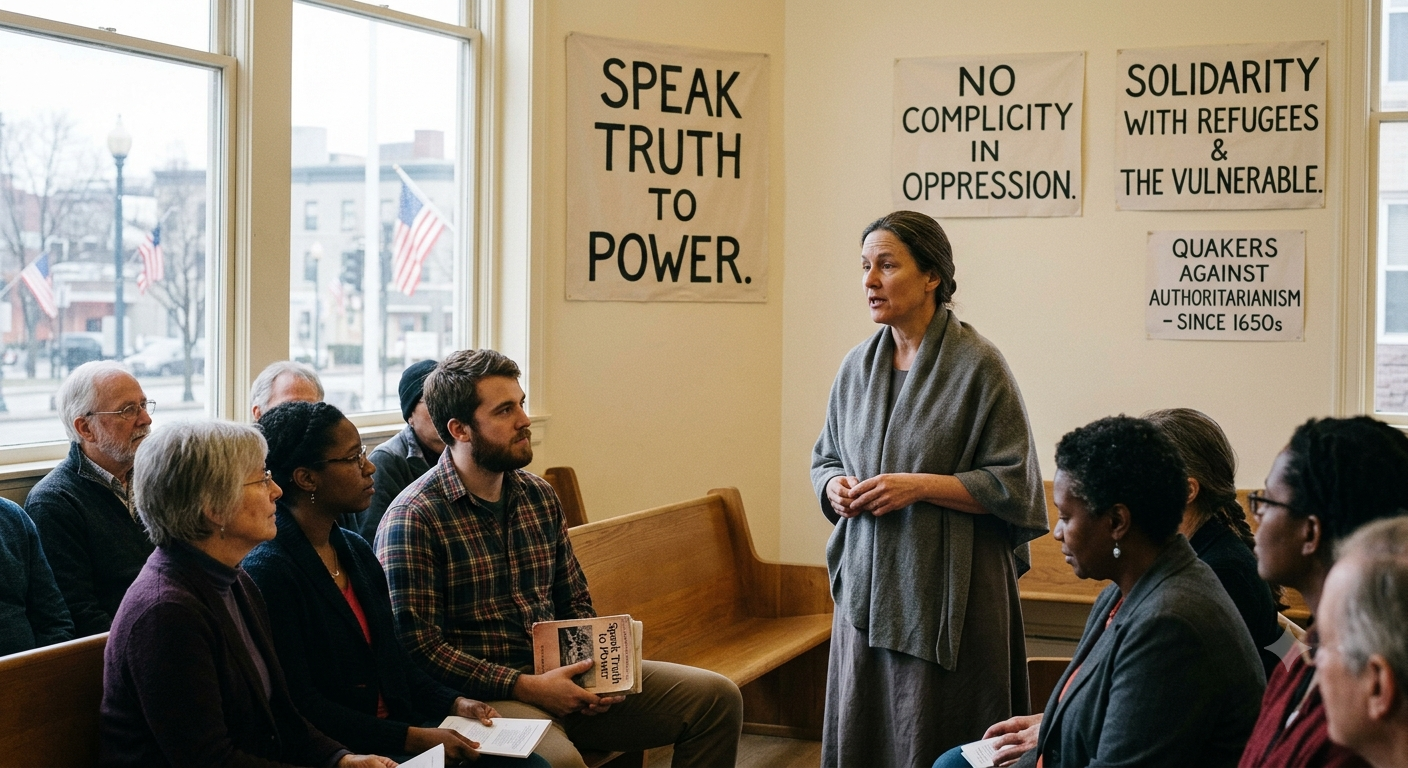
In 1955, the AFSC published the landmark document Speak Truth to Power: A Quaker Search for an Alternative to Violence. It called upon Friends and the wider public to examine the roots of conflict—including poverty, colonialism, and injustice—and to seek peaceful alternatives to militarism. Its title reminds us that faithfulness sometimes requires addressing those who hold power with honesty and moral courage.
Standing in Solidarity with Our Suffering Neighbors
We cannot isolate ourselves from the lived reality of our communities. From gun violence tearing through towns in Maine, to tragic shootings in Minnesota, to cities across America where families live in fear, our country is hurting. Instead of offering healing, modern political leadership fuels division, weaponizes anger, and encourages violence.
As Friends, we recognize “that of God in every person.” That means we must stand in radical solidarity with our brothers and sisters who bear the brunt of these political decisions:
Immigrants, Refugees, and Their Neighbors: We witness aggressive ICE operations, arbitrary detentions, and the militarization of enforcement in our neighborhoods. Families are torn apart, and long-standing community members are targeted without regard for human dignity or due process—treating children and parents as disposable.
The Poor and Vulnerable: We watch as safety nets are slashed, redirecting crucial funds away from hungry children, impoverished families, and essential community projects, while those at the top enrich themselves off the government.
The Pursuit of Truth: We see public officials lying openly in the news, manipulating public institutions, engaging in warmongering, and using government power for self-aggrandizement and personal profit.
When political power is used to take from the poor, shield the corrupt, and spread falsehoods, Jesus’ warning in the Gospels comes to mind: *”By their fruits you shall know them”* (Matthew 7:16). The fruits of this current political trajectory are cruelty, deceit, and division.
Reclaiming the Beacon on the Hill
In his Sermon on the Mount, Jesus told his followers, “You are the light of the world. A city that is set on a hill cannot be hidden” (Matthew 5:14). Decades ago, leaders like Ronald Reagan popularized that biblical image to describe America as a “shining city on a hill”—a beacon of freedom, democracy, and justice to the rest of the world.
Regardless of one’s political view of American history, that ideal meant something: it meant that we should aspire to be an example of justice, open democracy, and human rights. But how can America remain a beacon to the world when our own political leadership embraces authoritarian tendencies? How can we be a light when law is replaced by executive whim, when public funds are looted, and when violence is normalized?
If we allow this degradation of truth and justice to continue without a voice raised in protest, we forfeit our right to claim that beacon.
Our Voice is Our Power
Our testimony must begin in worship and discernment, but it cannot end there. Waiting upon the Spirit is not the same as waiting for someone else to act. The purpose of discernment is to help us see more clearly what love, truth, and justice require of us.
Friends will not agree on every policy, candidate, or political party. Our meetings include people with different histories, experiences, and convictions. We should not question one another’s faith merely because we reach different political conclusions. But neither should respect for difference prevent us from naming conduct that violates human dignity, undermines accountable government, or treats cruelty as a legitimate instrument of power.
We must measure every leader and every party by the same standard:
- Do they tell the truth?
- Do they respect the law when it limits their own authority?
- Do they protect the vulnerable?
- Do they recognize the humanity of immigrants, political opponents, minorities, and people living in poverty?
- Do they encourage peaceful democratic participation, or do they cultivate fear, humiliation, and violence?
Our response must remain faithful to the Peace Testimony. We should reject hatred even as we resist injustice. We should refuse dehumanizing language, including language directed at those with whom we strongly disagree. We should protect threatened neighbors, support honest public servants and election workers, defend the right of every eligible citizen to vote, sustain trustworthy local journalism, contact elected officials, participate in peaceful public witness, and provide practical assistance to people harmed by government actions.
Friends have never believed that peace means passivity. Peace is an active commitment to truth, justice, reconciliation, and the protection of human life. Our task is not to defeat human enemies, but to resist the fear, falsehood, greed, and hunger for domination that can take hold in every person and every institution.
The question before us is larger than which party prevails in one election. The question is whether we will remain faithful to the Light we profess to follow. Friends do not march with armies or wield political weapons. Our power is our moral voice, grounded in the Inner Light and guided by our Testimonies of Peace, Integrity, Equality, and Community.
Staying quiet in this moment is no longer an option. We must speak within our meetings, educate our neighbors, support those who are threatened, engage faithfully in our communities, and vote our consciences.
When future generations ask what we did while democratic institutions and vulnerable communities were under pressure, may we be able to say that we listened deeply, spoke honestly, acted courageously, and refused to surrender our neighbors to fear.
Let us show our fellow citizens that true faith does not bow to strongmen, tolerate cruelty toward the vulnerable, or remain passive in the face of tyranny. It is time to let our Light shine.