The Broken Foundation: Why We Are Falling Behind
Imagine a brilliant architect builds a beautiful house and leaves it to his children. But instead of taking care of it, the kids bicker, ignore the original blueprints, and let the building fall apart.
Our modern world feels a lot like that. We are trying to navigate a highly complex, connected society using old survival habits and temporary fixes. When our leaders treat massive societal problems as just standard business choices, the very foundation of our civilization starts to crack.
It makes total sense why so many people are walking away from organized religion today. When large institutions use God’s name to justify greed and power—the exact things religion is supposed to fight—the core message gets ruined. Because of this, thinkers, skeptics, and truth-seekers have left the room. They are tired of a hollow show that twists the command to “love your neighbor” into a weapon to shut people out.
To find our footing, we need to look past 2,000 years of religious rules and look directly at history. Jesus of Nazareth wasn’t a peaceful, glowing figure in a stained-glass window. He was a radical disruptor who flipped tables and challenged the corrupt leaders of his time. His message wasn’t about escaping this world, but about changing it right here and now.
The Design and the Human Condition
The Freedom Trait
Humans weren’t made to be robots executing hard-coded programming. We were given absolute free will, but that radical freedom comes with real consequences.
The Original Assignment
We were meant to be caretakers of the Earth. Our job was to work as partners to keep things fair, maintain harmony, and help the world thrive.
The Broken Cycle
As humans grew smarter and more powerful, we started rewriting the rules to benefit ourselves instead of the common good.
- We rebranded greed as “ambition.”
- We labeled exploitation as “just survival.”
- We built up complicated excuses to hide our own cruelty, burying the original truth under layers of self-deception.
The Trap of Rules and Rulers
To break this bad cycle, an early community (the ancient Israelites) tried a new way of living. They were given a simple framework—the Law—to help them treat each other fairly. But human nature got in the way.
The Checklist Shift: Instead of letting the law change their hearts, people treated it like a legal checklist. Empty rituals and ceremonies replaced real justice.
Eventually, the people got tired of being directly responsible to an invisible God. They wanted a tangible, human king to fight their battles and make decisions for them. The prophets issued a clear warning about what happens when you centralize power:
The people demanded a king anyway, and the result was a disaster. Unchecked power corrupted even the wisest rulers. Instead of protecting the people, the kings became the oppressors. By the end of their historical story, the society was shattered, divided, and on the brink of total collapse.
The History: First-Century Galilee
To understand what happened next, we have to look past religious stories and look at the real-world history of first-century Palestine. It was a violent, high-stress place.
The Power Vacuum
In 4 BCE, the brutal tyrant Herod the Great died. He left behind no clear plan for who should rule, which immediately sparked riots across the region. In Galilee, a rebel leader named Judas raided a royal armory in the capital city of Sepphoris, stealing weapons to start an armed revolt against Rome.
The Roman Response
The Roman government responded with terrifying force:
- They marched into Galilee and burned Sepphoris to the ground.
- They sold the surviving population into slavery.
- Rome divided the land, putting a new ruler, Herod Antipas, in charge of Galilee.
Antipas immediately started a flashy, expensive construction project to rebuild Sepphoris as a rich Roman city. This massive project sat right next to Nazareth, a tiny, poor farming village. The construction boom created a massive class of deeply exploited, desperately poor day-laborers. This is exactly where our story takes a turn.
The Worker’s Household
This tense, heavily policed environment was home to a family of tektons—a word often translated as “carpenters,” but which actually meant heavy day-laborers, stone-cutters, and construction workers.
- The Economic Reality: Joseph and his young wife, Mary, belonged to the working poor. We know this because when their first son, Jesus, was born, they couldn’t afford the standard temple sacrifice of a sheep. They had to use the poverty loophole, offering just two small birds.
- The Family Structure: Jesus grew up in a large, busy home with his brothers—James, Joseph, Judas, and Simon—and his sisters, feeling the direct pressure of heavy Roman taxes and poverty.
Despite their low status, this family had close ties to a spiritual resistance movement. Mary’s cousin gave birth to a wild, counter-cultural prophet named John the Baptist.
The Desert Movement
While Jesus worked as a laborer in Galilee, John was organizing a movement out in the desert, completely bypassing the rich religious elite in Jerusalem. John preached that the current world order was corrupt and faced imminent disaster. To help ordinary people start fresh, he offered a brilliant, anti-establishment shortcut: Baptism.
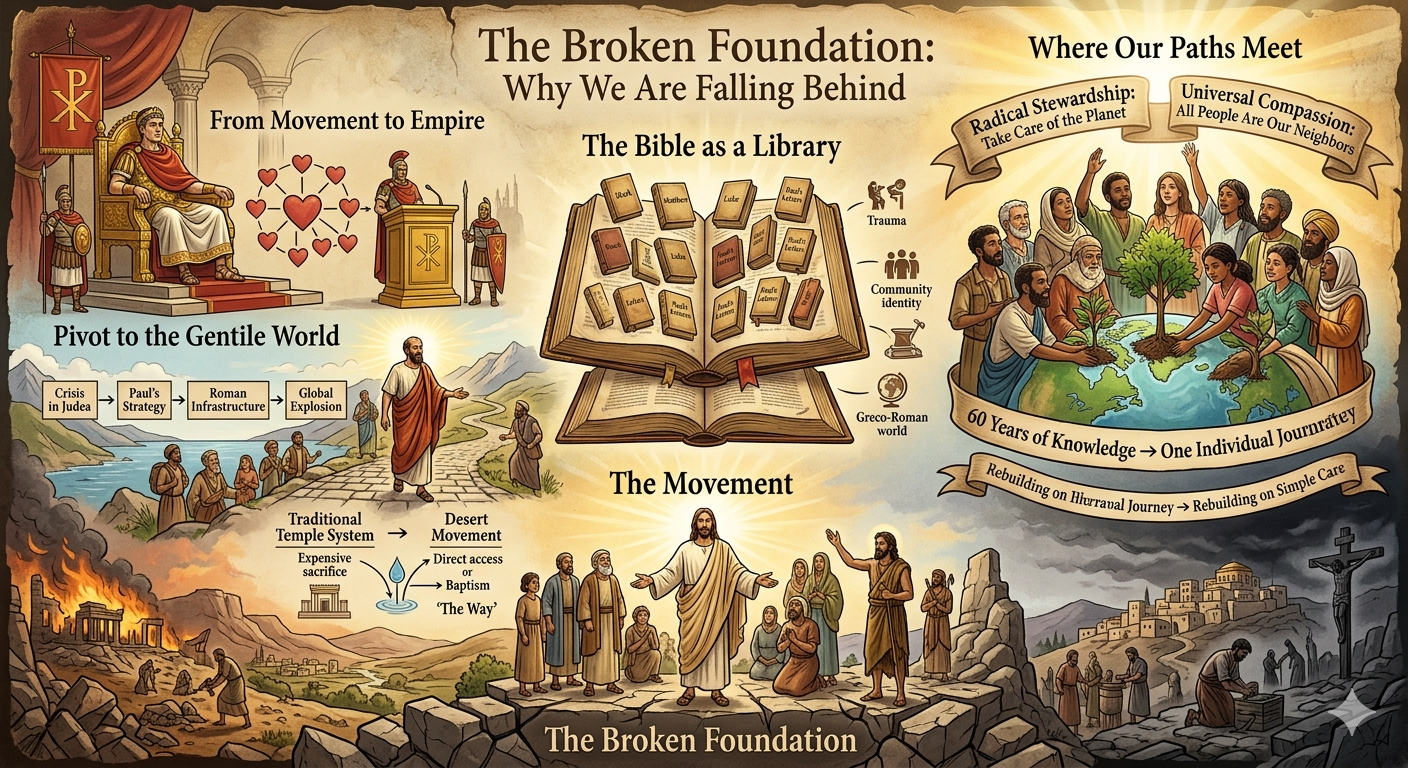
| Traditional Temple System | John’s Desert Movement |
| Required an expensive trip to Jerusalem | Accessible to anyone at the Jordan River |
| Forced people to deal with corrupt priests | Provided a direct connection to God |
| Demanded costly animal sacrifices | Required only true, inner repentance |
John’s movement, known simply as “The Way,” bypassed the commercialized religious system entirely. Around age 30, Jesus walked away from his construction job, traveled south, and was baptized by John, joining this radical movement.
The Simplification and the Backlash
Jesus took the urgency of John’s movement but shifted the focus toward radical love, healing, and inclusion. He looked at the hundreds of complicated religious micro-regulations and boiled them down to two undeniable truths:
- Connect directly to the Source: Align your heart with God.
- Practice unconditional compassion: Treat your neighbor’s well-being as identical to your own.
He stated that every other law and rule in history rested entirely on these two actions.
But the religious establishment did not want simplicity. Complexity gave them power, control, and profit. When they realized Jesus was a threat to their authority, they teamed up with the Roman government to execute him. They figured that killing the leader would destroy the movement. They were wrong. His execution proved to his followers that a life built on self-sacrificial love is completely indestructible.
The Pivot to the Gentile World
The execution of Jesus didn’t stop his immediate followers, but the movement faced an urgent survival crisis. Jesus had focused his work entirely on his own people, but the Jewish communities were not joining in flocks. To the vast majority of traditional Jews, a crucified leader looked like a failed movement, not a victorious savior. In its original homeland, the Jesus movement was rapidly losing ground.
Paul’s Radical Realization
The turning point came through a brilliant, highly educated scholar named Paul. Originally a strict defender of traditional boundaries, Paul experienced a total shift in perspective. He realized that if the message remained strictly locked within Jewish cultural laws, it would die out.
Paul bypassed the old religious debates and took the core message of John the Baptist and Jesus—radical equity, direct connection to the Source, and universal compassion—and re-packaged it for ordinary, non-Jewish people (known as Gentiles).
The Roman Paradox
In a strange twist of history, the very empire that executed Jesus created the perfect environment for his message to spread across the world. Rome was a brutal oppressor, but it unwittingly provided the infrastructure the early movement needed to survive:
- The Pax Romana (Roman Peace): For the first time in history, a single power controlled the entire Mediterranean world, making international travel relatively safe.
- The Imperial Highway System: Rome built thousands of miles of paved roads to move its armies. Paul and other early travelers used these exact highways to carry their message from city to city.
- A Common Language: Because of Roman and Greek conquests, people across different countries spoke a common language (Greek), allowing a single message to be understood by everyone.
Paul found a deeply receptive audience among the average working-class people of the Roman Empire. These people were exhausted by imperial cruelty and looking for a way of living that gave them equal dignity.
The Forced Separation
In 70 AD, the tension between the Jewish people and their Roman occupiers boiled over, and the Roman army brutally destroyed the Temple in Jerusalem. To traditionalists, this was the end of the world. But for the Jesus movement, it was a forced release.
Without a centralized holy building or a national headquarters in Jerusalem, the faith was forced to completely decentralize. It severed its final institutional ties to traditional Judaism and became an international, grassroots network living in the hearts of everyday people practicing the way of love.
How the Movement Became an Empire
As the movement grew, it caught the attention of the state. In the early 4th century, the Roman Emperor Constantine realized he couldn’t crush the movement by force, so he decided to absorb it instead.
The empire did what empires always do: it bought out the revolution. The cross—once a symbol of resisting government execution—was painted onto the shields of Roman soldiers. Institutional Christianity was born. It became a rigid, top-down organization designed to protect the king’s throne.
The Modern Firewall
The original message of liberation was buried under layers of rules and bureaucracy. The new system taught people that:
- Spiritual authority flowed downward through official church leaders.
- Obeying the institution mattered more than inner transformation.
- Protecting the organization was more important than loving the broken.
The movement that started by overturning the tables of greedy money-changers ended up building golden thrones. Over the centuries, this corrupted power was used to justify wars, conquests, and violence. But the failure wasn’t the blueprint; it was what happens when human power hijacks a message of love.
Understanding the Bible as a Library
To see through these historical layers, we also have to understand what the Old and New Testament actually is. It is not a single, uniform story dropped cleanly from the sky. It is an anthology—a library of 66 different books and letters written by different authors, spanning decades, to address specific crises and audiences of their time.
The Gospels (Matthew, Mark, Luke, and John) actually changed over time. Each author shaped their narrative to highlight what mattered most to their specific community. They are historical snapshots of early groups figuring out how to live out a revolutionary message in a changing world.
Where Our Paths Meet
Recognizing that these texts are records of distinct human journeys changes how we view faith. Religion is not a rigid set of dogmas to enforce; it is a history of people searching for meaning.
A Perspective on the Journey: This outlook comes from many years of reading, learning, and reflecting. However, my experience of knowledge doesn’t make anyone superior. It represents only one person’s journey among billions, and it holds no more inherent authority than yours. We are all equals on this path.
When we listen to different global traditions and strip away the complicated rules, a clean signal emerges from the noise. The various journeys of human spirituality are completely capable of meeting on the exact same path.
In the end, what God wants from us isn’t complicated. It relies on a dual imperative:
- Radical Stewardship: Acting as responsible caretakers of this planet.
- Universal Compassion: Recognizing that every human being, without exception, is our neighbor.
The final question isn’t about which religious group we belong to. The real question is whether we are willing to step onto this shared path, honor each other’s unique journeys, and rebuild our broken world through simple, everyday care.